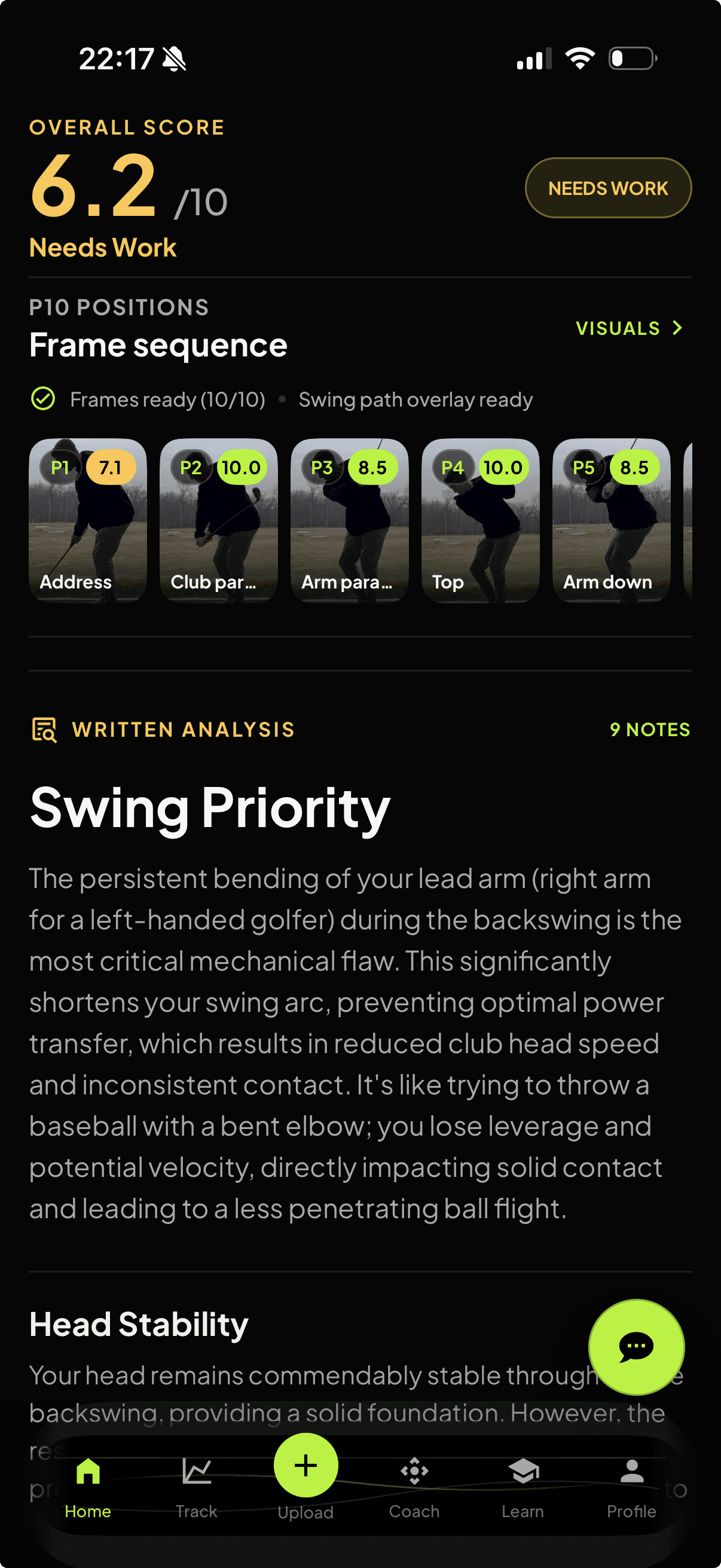
Tempo issues rarely come from speed alone. A long backswing, rushed transition, stalled body turn, or late release can all change the strike. SwingSmith turns a normal swing video into a score, P10 frame sequence, written priority, and visual feedback so the next practice session has one timing checkpoint to test.
Record timing
Review P10
Test one cue
A simple tempo practice workflow
Step 1
Record a normal swing
Capture the swing pattern you want to understand, especially the tempo that shows up when contact, curve, or strike quality breaks down.
Step 2
Review the P10 sequence
Use the frame sequence, score, written priority, and visuals to see whether setup, takeaway, top, transition, or release is driving the timing issue.
Step 3
Pick one timing checkpoint
Practice from one visible priority instead of trying to fix backswing speed, transition, pressure shift, and release all at once.
Step 4
Compare the follow-up swing
Upload the next swing from the same angle so rhythm changes are tied to visible positions, not only feel.
What to check before changing tempo
Tempo is not just swing speed
A rushed transition, long backswing, late pressure shift, or stalled turn can all feel like a tempo problem. Good feedback should look at the sequence behind the timing.
The top of the backswing matters
If the club, lead arm, or body position is out of sync at the top, the downswing often has to recover. The fix may start before impact.
One priority keeps practice readable
Tempo changes are hard to judge when several mechanics change together. A single checkpoint makes the next range, net, or simulator session easier to compare.
Good fits
Golfers who feel quick from the top and lose contact when they try to swing harder.
Players whose backswing gets long, disconnected, or hard to sequence under pressure.
Range and simulator sessions where ball speed or carry changes need a visible swing checkpoint.
Coaches who want players to bring a repeatable P10 sequence into the next lesson.
Start with the swing that loses rhythm
Upload the swing and practice from one timing priority
Install SwingSmith, upload a clear swing video, and use the analysis to decide what to test at the next range, net, simulator, or lesson session.
It can help by turning a swing video into positions, sequence notes, and one practice priority. Tempo is not only speed, so SwingSmith looks at the visible checkpoints around setup, backswing, transition, impact, and release.
Is tempo the same as rhythm?
They are related. Tempo usually describes the timing relationship between backswing and downswing, while rhythm is the overall flow of the motion. A useful analysis connects both to visible swing positions.
Should I slow my golf swing down?
Not automatically. Slowing down can help some players, but others need a cleaner transition, better top position, or more connected sequence. SwingSmith is useful because it points to a visible priority instead of guessing from feel.
Can this help with range, simulator, or home-net practice?
Yes. Phone video can show the tempo and sequence pattern even when the practice setting changes. Use the same camera angle when you want to compare progress over time.
Do golfers upload swings on this website?
No. Swing analysis runs inside the iOS and Android app so uploads, results, history, and coaching tools stay connected.
Explore SwingSmith
Start with the core app, analyzer, coach, and support paths. Specific swing-topic pages stay linked from the articles where they are most useful.